FOREWORD
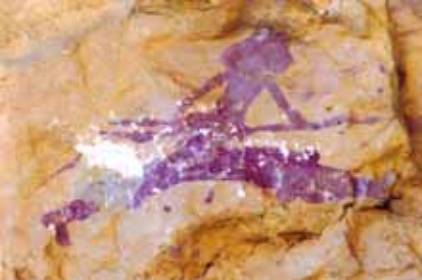 During
the 2002-2003 academic year, we spent three periods studying the prehistoric
paintings that are located in the Martín River Cultural Park; they
are considered a major cultural asset within Mediterranean Prehistoric
Art, they have become a Unesco World Art Heritage site in the year 1998.
During
the 2002-2003 academic year, we spent three periods studying the prehistoric
paintings that are located in the Martín River Cultural Park; they
are considered a major cultural asset within Mediterranean Prehistoric
Art, they have become a Unesco World Art Heritage site in the year 1998.
We wanted to know about the life and customs of the people that lived here a long time ago. Since the visit and study of the cave paintings of the Chaparros Shelters, of the River Narrowings in Albalate del Arzobispo and of the Mount Felío in Alacón, we have drawn, in our own way, these prehistoric figures. Our drawings also served other purposes: illustrating the calendar that we made in the arts workshop, painting a mural on a playground wall, making sculptures on wood, making didactic games and decorating T-shirts.
WORK PROCEDURE
WHAT ARE CAVE PAINTINGS?
 They
are drawings that our ancestors painted many years ago on the mountain
shelters or in shallow caves. They are painted in red and black colours.
To make different colour paints, they used to grind down clay or charcoal
and the powder obtained was then mixed with water, blood, resins, animal
fat or the white of the egg.
They
are drawings that our ancestors painted many years ago on the mountain
shelters or in shallow caves. They are painted in red and black colours.
To make different colour paints, they used to grind down clay or charcoal
and the powder obtained was then mixed with water, blood, resins, animal
fat or the white of the egg.
On the walls of the caves they used to draw people, some times hunters with their weapons, other times a pregnant woman or a couple of people that look like boyfriend and girlfriend… The also painted many animals: wild boar, deers, horses, wolves, bulls, donkeys… Other paintings are symbols made of geometric figures.
These paintings have lasted so long because they are in the mountain shelters, protected from the wind and the rain.
In the cultural park of the Martin River, besides the prehistoric paintings which we saw at the "Chaparros", there are many more in other places such as the Narrowings of the river in Albalate del Arzobispo, Oliete, Alcaine, Obón and Alacón; in this last one, there is a beautiful figure called the archer.
HOW HAVE WE INTERPRETED THE CAVE PAINTINGS?
 First:
In the classroom we prepared the excursion; we got information about what
we were going to find out, we watched a video on life in the Prehistory
and we were given a sheet of paper to learn about the cave paintings of
the "Chaparros".We concentrated our attention on the things
that were more important.
First:
In the classroom we prepared the excursion; we got information about what
we were going to find out, we watched a video on life in the Prehistory
and we were given a sheet of paper to learn about the cave paintings of
the "Chaparros".We concentrated our attention on the things
that were more important.
Second: In the "Chaparros" shelter, the guide showed us the paintings, and every time that we found a familiar figure, we highlight it on the sheet of paper that we had been working in the classroom.
Third: On the following days, when we returned to the school, we carried on learning about some other cave paintings of the Martin River which we found in other books.
Fourth: Every one
of us chose several figures, those ones that we liked most. During some
sessions we drew them in our own way and we marked them clearly. Then
we gathered together all the drawings in order to make this magazine and
to illustrate our calendar of the year 2003.
1.- EXCURSION TO THE CHAPARROS
 On
Wednesday the 6th of November, the students of 6th, 7th, 8th, and 9th
levels, went to an excursion with our teachers to the cultural park of
the Martín River. Before arriving to Ariño, on the side
of the road, we saw footprints of Dinosaurs which were highlighted with
white chalk ; then we went to see the Arcs Virgin and the cave paintings
of the "Chaparros".
On
Wednesday the 6th of November, the students of 6th, 7th, 8th, and 9th
levels, went to an excursion with our teachers to the cultural park of
the Martín River. Before arriving to Ariño, on the side
of the road, we saw footprints of Dinosaurs which were highlighted with
white chalk ; then we went to see the Arcs Virgin and the cave paintings
of the "Chaparros".
At the sanctuary of the Arcs Virgin, Antonio, our guide, was waiting for us; he accompanied us the whole day. There, José María, explained to us about the map of the Martin River, as we were going to make a scale model at the school. We saw a waterfall, the mountains and the river down below. Some nuns used to live at the sanctuary, but now it is all a ruin and the nuns have left.
At noon we set off walking on the route of the Martin River. At the beginning of the walk we saw an information panel about how we should respect Nature: don't make it untidy, don't light fires… and then we carried on walking on a very narrow footpath.
On the way, there were information panels that were very useful to us because they explained to us the names of the birds, about the prehistoric paintings, and the flora and the fauna of the Martin River.
Our teachers showed us various kinds of plants: Sabina, Lentisco, Poplar… and others that smelt very well, like rosemary. Also, we saw a plant that had a terrible smell if you were to touch it or move it, its name is "Ruda".
From a vantage point we saw how the Martín River flowed through the valley, which became narrower and narrower, as if squashed by the mountains. With our binoculars we saw vultures, which are birds that eat dead animals.
We walked for more
than one hour to arrive to the prehistoric painting caves that are at
a river bend called the "Chaparros". The cave paintings are
protected by a wire fence, so that people can not get too close, and damage
them. Antonio explained to us about the paintings and then we had to find
them and mark them on a sheet of paper that our tutors had given to us.
OUR OPINIONS
"In this excursion I have had a great time and I liked everything that we saw and walking was very good for my health. Also I was very interested in the prehistoric paintings and I would like to go on another excursion". (Lucia)
"I liked the paintings because I had never seen them before. Now I like them because I have been able to see them and know more about them". (Jose Maria)
"The prehistoric paintings have been very interesting because they are the kind of things that used to be done in those days." (Sara)
"I had a very good time in this excursion, I liked the cave paintings very much and I enjoyed the flora and the fauna as I am interested in Nature." (Oscar)
2.- THE MAGAZINE
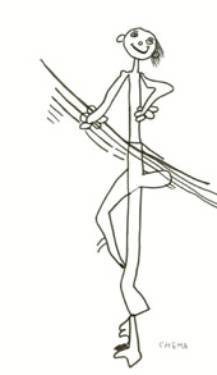 We
made a magazine where we wrote everything that we had written during the
lessons about the cave paintings, which we had seen on the excursions
to the Martín River Cultural Park.
We
made a magazine where we wrote everything that we had written during the
lessons about the cave paintings, which we had seen on the excursions
to the Martín River Cultural Park.
We also included in the magazine sketches of the cave paintings;next to them we put our own drawings and a small explanation, which the teacher made, about the location of the paintings, what they represented, and the names of the boys and girls that had made the drawings.
We took the magazine to the printers in order to have 300 copies made.
After that, we gave a magazine and a calendar to every body at the school.
The magazine came out very well.
3.- HOW HAVE WE MADE THE CALENDAR?
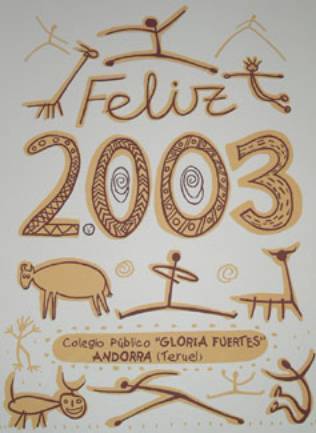 This
year's calendar is about cave paintings, as we are studying the Martín
River Cultural Park in a project with some European Schools. We made it
as follows:
This
year's calendar is about cave paintings, as we are studying the Martín
River Cultural Park in a project with some European Schools. We made it
as follows:
1st. We all made drawings in our own way; we chose a few from each one. We also made the numbers for the months.
2nd. We marked clearly the chosen drawings with a fine but fat black feltip; then we cut them out and glued them on card.
3rd.Jose María, the art and design teacher, took the drawings to his house, put them under a light with transparent paper so that the drawings get printed on a screen.
4th. In the Plastics Workshop, we secured the screen with screws in order to centre the drawing.
5th. We placed a card under the screen and poured paint on it; then we pressed the paint to print a calendar sheet.
6th. We got the sheets out and hung them up to dry.
7th. We made different piles of sheets, following the order of months; then we reviewed all the sheets in order to make a selection of the good, the bad and the average.
8th. Finally, we gathered one of each of the different sheets, made holes, and tied them up with a thin piece of rope.
9th. We made 350 calendars. We delivered calendars to every classroom and office of our school; we also sent them to the other schools that are involved in this project about studying parks in their own country. We sold the remaining calendars to get money for the trip that we are going on before the summer holidays.
4.- BETHLELEM SHELTER
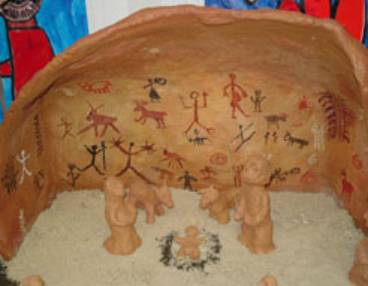 At
Christmas, as every year, we set up a Bethlehem (a scale model with little
statues that represents the birth of Jesus). This year the shelter was a
cave that we made with plaster; we painted prehistoric drawings on its walls.
We used red and black colours, as we had seen them during the excursions
to Martin River Cultural Park. To make the structure of the cave we used
a piece of metal netting, which we bent to make the shape of a prehistoric
shelter. We liked the cave very much.
At
Christmas, as every year, we set up a Bethlehem (a scale model with little
statues that represents the birth of Jesus). This year the shelter was a
cave that we made with plaster; we painted prehistoric drawings on its walls.
We used red and black colours, as we had seen them during the excursions
to Martin River Cultural Park. To make the structure of the cave we used
a piece of metal netting, which we bent to make the shape of a prehistoric
shelter. We liked the cave very much.5.- VISIT TO THE CAVE PAINTINGS INTERPRETATION CENTRE "ANTONIO BELTRÁN" IN ARIÑO
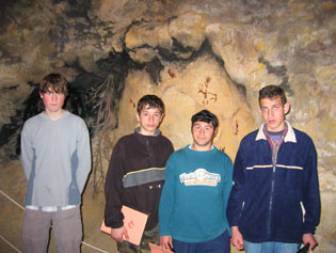 Wednesday
March the 5th we went to Ariño to see the cave paintings Interpretation
Centre.
Wednesday
March the 5th we went to Ariño to see the cave paintings Interpretation
Centre.
There we saw how our ancestors grind down stones, (red stones that contain iron, black stones that contain manganese and coal) and then, they mixed them with blood, egg, resin and water to make the painting dye.
When we got there we made groups, every level went with their tutor. There, we saw a manmade cave with paintings; this is for the people that are unable to see the real caves so that they may have some idea of what the caves look like in reality.
We saw a scale model of the cultural park of Martin River; this shows the river, the valleys and surrounding mountains that range from two hundred to thirteen hundred metres.
There were information
panels about the cave paintings and maps of every village. There were
also monkeys heads that represented our ancestors.
Then we went to a park to have a mid-morning snack.
OPINION
There were photographs showing the cave paintings, they were the same ones that we had been making drawings of; we liked them very much.
6.- EXCURSIÓN TO THE NARROWINGS OF THE MARTÍN RIVER
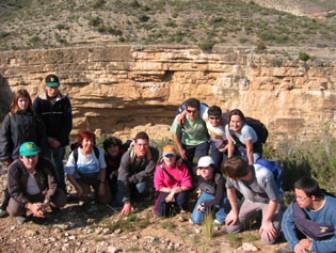 After
the snack we got on the bus and went to see the Narrowings of the Martin
River.
After
the snack we got on the bus and went to see the Narrowings of the Martin
River.
We walked for almost
one hour. When we got there, we crossed the river and climbed up to a
cave to be able to see the prehistoric paintings with our binoculars.
After that we went down to have lunch altogether.
After our lunch we went to see the Rivera Hydroelectric Power Station.
We climbed down a steep and narrow staircase and we got close to a waterfall,
it was breath-taking. We had some pictures taken there.
Later we walked back to the bus, and returned to our school.
In the excursion we learned lots of things and the waterfall impressed
us very much, because there was so much water.
7.- TALK AND SLIDESHOW
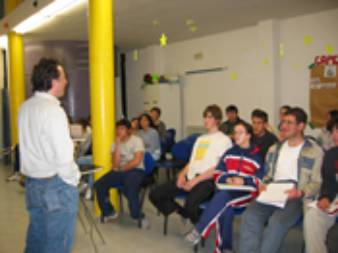 On
March 5th, José Royo, who is the coordinator of the Martín
River Cultural Park, and a very knowledgeable person on Prehistoric Art,
explained to us how people lived and ate in the Prehistory, where they took
shelter, what their customs, beliefs and rites were by using projected slides
about cave paintings.
On
March 5th, José Royo, who is the coordinator of the Martín
River Cultural Park, and a very knowledgeable person on Prehistoric Art,
explained to us how people lived and ate in the Prehistory, where they took
shelter, what their customs, beliefs and rites were by using projected slides
about cave paintings.8.- THE MURAL
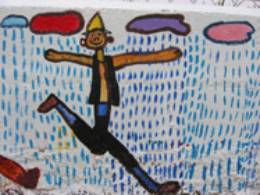 We,
the boys and girls from the Gloria Fuertes School painted the cave paintings
on a mural that we made on the wall of the playground. The mural is 51
metres long.
We,
the boys and girls from the Gloria Fuertes School painted the cave paintings
on a mural that we made on the wall of the playground. The mural is 51
metres long.
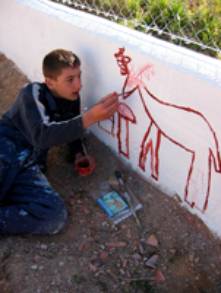 We
modified some of the paintings by adding objects from nowadays. We drew
a woman shepherd with a mobile phone, the archer with a guitar, warriors
with banners that say "peace, no to war". To make the mural,
we first painted the wall white. After that the small children printed
the palms of their hands with paint and then we painted the rest. We used
our own drawings as models to paint them on the wall with paint brushes
and paint. Later on, when it was dry, photographs were taken and recorded
on video. The mural came out very well; lots of people have seen it and
have liked it.
We
modified some of the paintings by adding objects from nowadays. We drew
a woman shepherd with a mobile phone, the archer with a guitar, warriors
with banners that say "peace, no to war". To make the mural,
we first painted the wall white. After that the small children printed
the palms of their hands with paint and then we painted the rest. We used
our own drawings as models to paint them on the wall with paint brushes
and paint. Later on, when it was dry, photographs were taken and recorded
on video. The mural came out very well; lots of people have seen it and
have liked it.
9.- THE SCULPTURES
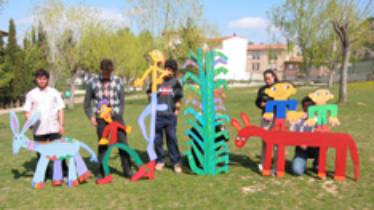 Based
on the drawings, which we had made from the cave paintings, we made some
large sized figures, as tall as a person.
Based
on the drawings, which we had made from the cave paintings, we made some
large sized figures, as tall as a person.
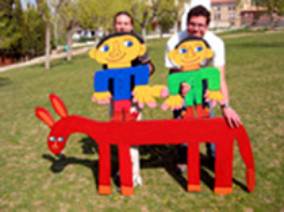
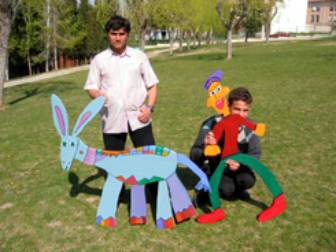
José María, using a projector, projected the silhouettes of the cave paintings on wooden boards, so that we could draw their siluettes; then in the carpentry workshop we cut the figures out with the jigsaw. After that we painted them white, and once they where dry, we painted them in different colours.
We hung these sculptures all around the school; they look very nice.
During the summer, we took them to the Prehistoric Art Interpretation Centre in Ariño, where they are being shown from August 2nd to September 27th; we put every sculpture in the room with their photograph of the cave paintings. Every room represents a different cave.
10.- DIDACTIC GAMES
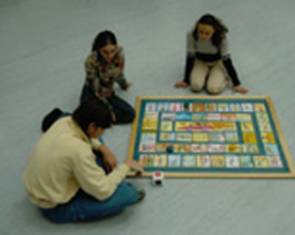 We
made games with our drawings of the cave paintings. The first one is dominoes
where you match images, and the second is a board game. We made these
games out of wood.
We
made games with our drawings of the cave paintings. The first one is dominoes
where you match images, and the second is a board game. We made these
games out of wood.
To make the dominoes, we cut the wooden rectangles, we sand papered them, we made them round, we painted them, and finally we stuck the drawings with varnish.
11.- EXCURSION TO ALACÓN
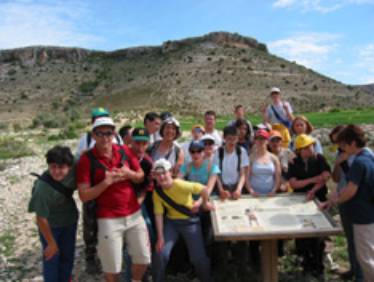 On
Tuesday, April 29th we arrived to Andorra and we entered our school to
wait for everybody and then we got on to the bus to go to the little village
called Alacón. This is the village where Alfonso comes from.
On
Tuesday, April 29th we arrived to Andorra and we entered our school to
wait for everybody and then we got on to the bus to go to the little village
called Alacón. This is the village where Alfonso comes from.
When we arrived to Alacón we went to see the cave paintings.
A very nice guide called Mari accompanied us and we set off walking; a while later we arrived at the shelters where the cave paintings are. There, we saw a few figures. The famous archer was the one that we liked best and we were very happy to see it because we already knew it from a big photograph that Alfonso has got; in the cave it is actually much smaller. There were also deer and other animals too. Later we had a rest and a snack. The countryside was very beautiful. Peña was recording with the video camera so that we could see it later at school.
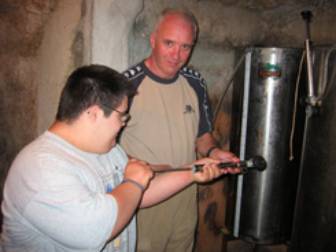 Then
we came back down on the same footpath. After that we went to Alfonso´s
cellar. He showed it to us and explained us about the process of harvesting
the grapes and of wine making. Inside the cellar it was cool and there were
loads of different wines, that smelt a lot. Apart from Alfonso´s cellar
there were many more.
Then
we came back down on the same footpath. After that we went to Alfonso´s
cellar. He showed it to us and explained us about the process of harvesting
the grapes and of wine making. Inside the cellar it was cool and there were
loads of different wines, that smelt a lot. Apart from Alfonso´s cellar
there were many more.
After that we went
to see Alacón´s Paleontologic Interpretation Centre and we
saw:
· Snail fossils and other similar ones which are made of stone.
· There was an animal which was something in between a crocodile
and a lizard.
· A huge dinosaur which was inside a cave.
· We saw a cave full of dinosaur bones, there was a pick and some
sort of rope to measure the ground and also to get the bones out without
breaking them.
· There were human skulls and they were very strange.
· We saw a man' s head that looked like a monkey.
Later on we went to a vantage point where we could see a great view of the countryside and we had lunch there and after that we went to see more cellars.
In the end we got on the bus and returned to Andorra.
OPINION
We had a great time in Alacón which is a small village and is very good. We also liked the cave paintings very much.
The weather that day was very good too.
12.- EVALUATION
 Our
participation in this work has been very interesting, because we have got
to know the customs and art of the people that painted the prehistoric figures.
Our
participation in this work has been very interesting, because we have got
to know the customs and art of the people that painted the prehistoric figures.
Many people that have seen it have liked the drawings and the work, which we have done. We have received many congratulations, and for all our work, we were given the 1st prize in the contest "New readings of ancient monuments", which the UNESCO Catalan Centre had organised; a trip to Paris was awarded to all the students that had participated in this work