

MALE REPRODUCTIVE SYSTEM
The male reproductive system produces sperm
The male reproductive system is divided into two major parts:
- External genitalia
-
Internal reproductive organs
EXTERNAL GENITALIA
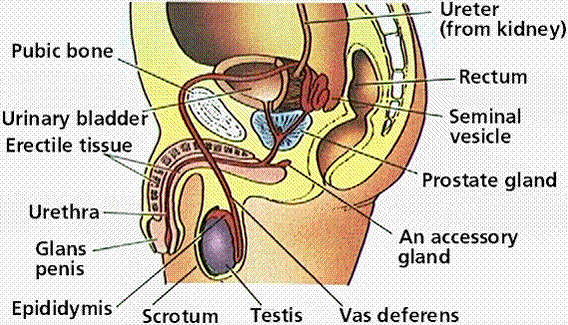
External genitalia are: penis, glans penis, prepuce and scrotum.
Penis contains three cylinders of spongy named erectile tissue, they fill of blood causing an erection,which is necessary for insertion of the penis into the woman’s vagina.
The head of the penis, the glans penis, is very sensitive to stimulation.
The glans is covered by the foreskin or prepuce.
The scrotum is a bag of skin that maintains testes outside of the abdominal cavity where the temperature is about 2º C lower.
INTERNAL REPRODUCTIVE ORGANS
Internal reproductive organs are: testes, epididymis, vas deferens, ejaculatory ducts, urethra and accessory glands (seminal vesicles, postate gland and Cowper’s glands)
Sperm are produced in the testes, located in the scrotum. From there, sperm are transferred to the epididymis, when they are stored. In ejaculation, sperm are forced up into the vas deferens, the ends of the vas deferens are called the ejaculatory ducts, which empty into the urethra.
Seminal vesicles produce secretion that contains mucus and fructose. Fructose is the main energy source for the sperm.
Prostate gland is the largest of the accessory glands, it produces an alkaline secretion that neutralizes the urethra acidity.
Cowper’s glands, their fluid secretion serve as a lubricant for inserting the penis into the vagina.
FEMALE REPRODUCTIVE SYSTEM
The female reproductive system makes eggs.
The female reproductivesystem is divided into two major parts:
- External genitalia
- Internal reproductive organs
EXTERNAL GENITALIA
External genitalia are: labia minora, labia majora and clitoris.
Labia minoraandlabia majora are skin folds that cover the opening of the urinary tract and the vagina.
Clitoris is the female equivalent of the penis, this small estructure contains erectile tissuesand is the most sensitive point for females.
INTERNAL REPRODUCTIVE ORGANS
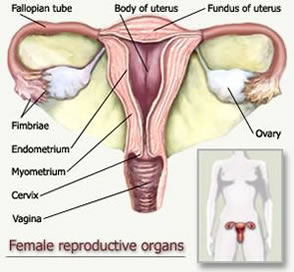
Internal reproductive organs are: ovaries, Fallopian tubes, uterus and vagina.
Eggs are produced in the ovaries. Each egg is released into the abdominal cavity near the opening of one of the Fallopian tubes. If sperm are present in the fallopian tube the eggwill be fertilized there and embryo will start travels to the uterus.
The uterus has thick, muscular walls, the internal part of the uterus is called the endometrium, in the uterus the fertilized egg implants and the embryo grows.
The vagina is a relatively thin conduct, it is where the penis is inserted and also serves as the birth canal.
