|
The city of Philadelphia
-
Location
and other features
-
A
bit of history
Location and other features
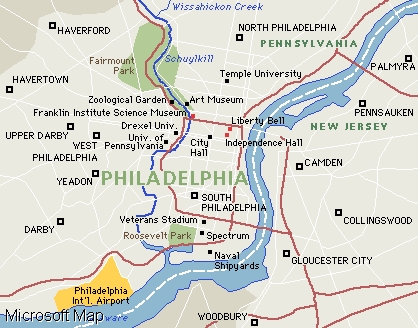
The fifth largest city in the United States, Philadelphia is located in
the southeastern corner of the state of Pennsylvania
Philadelphia is a major port situated approximately
halfway
between New York and Washington. Both the Declaration
of Independence and the United States Constitution
were drafted here-hence Philadelphia is the birthplace
of the nation and has been an important commercial,
industrial, and cultural centre. Philadelphia's economy is a complex system
of manufacturing,commercial, service, and research activities.
The
Port of Philadelphia, on the Delaware River, is one
of the world's
busiest freshwater ports and a major US
port
of entry that handles more than 5,000 cargo ships
each
year. Central high-rise buildings house office
headquarters
of major regional, national, and international
corporations, as well as the research facilities of some of the country's
leading pharmaceutical, computer, and technology-based
companies,
are here.
Manufacturing includes such items as transport equipment,
containers, printed materials, and fabricated metals;
ice cream, baked goods, and other food products are
also made here.
Six medical schools, numerous colleges
and universities,a nd
private research oriented firms provide the impetus
and facilities
for major research activities in science, technology,
medicine, economics, communications,and architecture.
Philadelphia
is situated on a relatively level site and islaid out in a regular grid
pattern, the first city in America
to be planned in such a manner, The heart of the city centre, which is
known as Center City, is marked by the
intersection of Broad and Market streets, the city's
two main
thoroughfares.
A bit of history
Since the 1950s the appearance of central Philadelphia has changed
dramatically as a result of major redevelopment and restoration projects.
In eastern Center City, the Society Hill area (named after the Society
of Friends) has been transformed from a decaying area into an affluent
urban residential village with numerous restored 18th- and early 19th-century
town houses.
Independence Mall and Independence
National Historical Park, located in this area, contain restored structures
that were prominent in early American history. Penn Center, across from
City Hall, was the first of several high-rise commercial and office complexes
to be completed.
Until 1986, with the construction of
the Liberty Place complex a "gentlemen's agreement" prevented the construction
of new buildings which exceeded the height of City Hall.
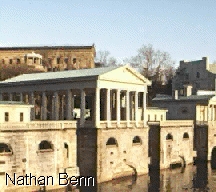
Today Philadelphia's transformation distinguishes itself by the preservation
of the old and the integration of the new; thus, a restored 18th-century
town house may sit comfortably in the shadow
of modern metal-and-glass high-rise buildings. The Pennsylvania Convention
Center, completed in 1993, is located between Arch and Race Streets.
An
enduring feature of Philadelphia is its mosaic of neighbourhoods, most
of which are regularly referred to by their proper names, such as Germantown,
Manayunk, East Falls, and Queen Village. Many of them retain the ambience
of the ethnic groups who settled in them. Major districts include South
Philadelphia, which is known as an Italian neighbourhood, and West
and North Philadelphia, which are predominantly black neighbourhoods.
Philadelphia has buildings of outstanding architectural interest. Independence
Hall, Carpenter's Hall (the site of the First Continental Congress), the
First and Second Banks of the United States, the Liberty Bell, the Betsy
Ross House (where in 1777 the first American flag is reputed to have been
made), and Christ Church (where Benjamin Franklin is buried) all lie within
a few blocks of one another in the historic district. Also located in the
city is the Veteran's Stadium, home of a major league baseball and football
team.
The
University of Pennsylvania and an associated hospital and other schools,
along with adjacent Drexel University (1891), form the heart of University
City. Temple University is one of more than a dozen other colleges and
universities, including La Salle University (1863), Thomas Jefferson University
(1824), Curtis Institute of Music (1924), University of the Arts (1876),
and Moore College of Art and Design (1844).
The Walnut Street Theater, opened in 1809, is the oldest active theatre
in the United States. The handsome Academy of Music, constructed in 1857,
is the home of the Philadelphia Orchestra, one of the finest symphony orchestras
in the world.
Among
the city's museums are the Philadelphia Museum of Art, the Rodin Museum,
and the Pennsylvania Academy of the Fine Arts, which houses an art school
as well as the oldest (established 1805) art museum in the United States.
Other
museums include the Academy of Natural Sciences (1812), the oldest natural
sciences museum in the United States; the Franklin Institute (1824), the
oldest science and technology museum in the United States.
This page has been created
by Joan Casas
back |