ACTIVITY 11:
MUSICAL ARCHITECTURE
- Retrieve the piece BOURREE. Find the repetition signs and explain what they do.
Do the same with the piece ANNAMIN1.
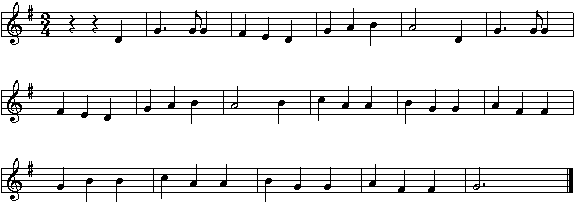
- Write the following piece into the computer using the repeat signs for the bars that are exactly the same. Find out how to edit the begin repetition and end repetition signs.
|
| 
|
Using the program "Music": to enter these symbols use the begin repeat key (semicolon ;) and the end repeat key (colon :).
|
You can write in the repetitions that are not joined together by marking and moving blocks. To do this, go to the beginning of the block you want to copy, select the part as a block (normally the background changes to reverse video), move to where you want to insert the block and press the choose option. In this way you avoid having to rewrite a whole phrase.
|
|
|
Using the program "Music": go to the start of the bars you want to copy, press the < key (begin and end block), go to the end of the block (which will change to reverse video), press the < again, move to where you want to insert the block and press Ins (Insert note or block). Having done this, unmark the block by pressing > (cancel block).
|
¿Cómo quieres que tenga? (Spain)
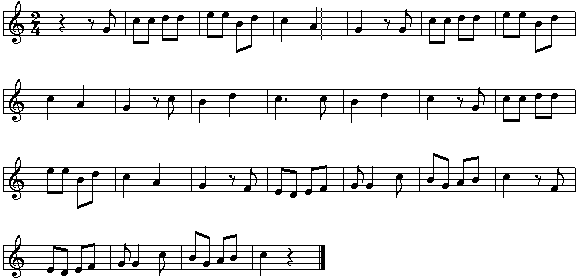
Do the same with the pieces: Pentozalis, O che bel castello and The Gay Gordons which you have already worked on in the previous exercise.
- Retrieve the song J'ai du bon tabac under the file name of BONTABAC. Listen to it and notice that you can divide it into two pieces, the first of suspensive character and the second of conclusive character.
J'ai du bon tabac

- Analyse this song. Indicate the four parts into which it can be divided, and whether the endings of each part are suspensive or conclusive. You will find it with the file name ALEMANYA.
Popular
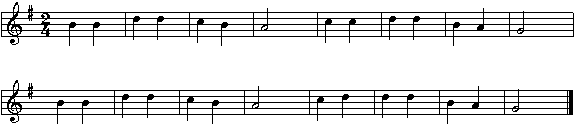
Do the same with these pieces with the file names: MERRILY and GRONINGS.
Merrily we roll along (United Kingdom)
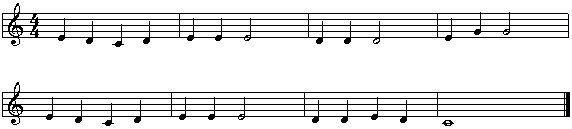
Gronings liedje (The Netherlands)
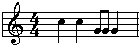
- Starting with the following motifs, write two phrases of eight bars for each one, divided into two periods respecting the structure aa'. The first period will be suspensive (not finishing with the note C), and the second conclusive (finishing with C, preferably with a long note value).
1st Motif
2nd Motif
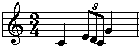
Having done that, you can play them on an instrument.
- Starting with the following phrase, from the file FRASE, create various pieces with the following structures: A:, AA', AB, A:BA:, ABACA.

- Retrieve the following pieces and relate them to their corresponding structures.
- Starting with the theme from Berlioz' Dies irae make two rhythmic variations: the first with filled notes and the second with dotted quarter notes and eighths. The theme is in the file DIESIRE2.

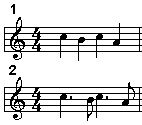
Now listen to the excerpt of the 5th movement from Berlioz' Fantastic Symphony and see that the tubas play the theme, the trombones the variation and the piccolo or flute play the 2nd.
- Beginning with the following melody, create two free variations. The melody is in the file named MAMAN2.
Ah, vous dirai-je Maman
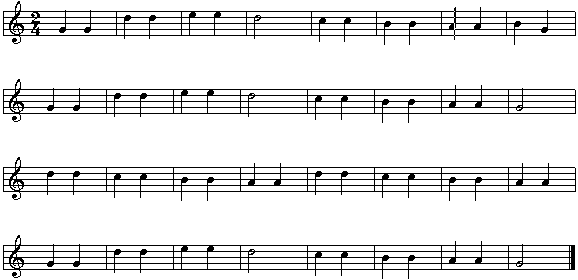
Having completed this exercise the teacher will play you some of Mozart's variations on the same theme in the work: 12 variations in C minor on the melody Ah, vous dirai-je Maman for piano (K265).
|

 Description of the activity