Synthesisers with keyboards
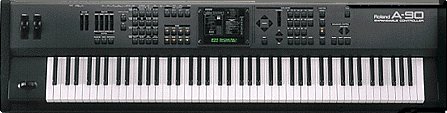 These instruments incorporate a MIDI controller (the keyboard) and an internal synthesiser. Most of the functions of selecting and editing tones are accessible through various command buttons, and there is usually a liquid crystal screen as well, which shows the different options selected. It is also possible to link a synthesiser up to other MIDI devices, through the MIDI In, Out and Thru ports at the back of the device. Some models also have a floppy disk drive that allows them to operate as sequencers: these models, integrating the three types of MIDI device (controller, sound generator and sequencer), are called workstations.
Other MIDI devices
Apart from these basic peripherals, a MIDI system may have additional devices with many different functions:
- External sequencers, small computers specially adapted to process MIDI data.
- Automatic arrangers, capable of processing MIDI data in real time and generating orchestrations and arrangements.
- Generators with various effects (reverbs, delays, filters, etc.)
- Voice-to-MIDI converters, which let you control a MIDI device while singing into a microphone.
- Percussion sound modules, devices specialised in percussion sounds with prefabricated rhythm patterns.
- Modules using MIDI information to control stage lighting.
- Movement sensors, which act like MIDI controllers where music can be performed through dance.
 Peripherals
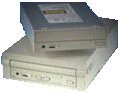 CD-ROMs use the same medium as music compact discs, except for the fact that a music CD only contains music, whereas a CD-ROM may also include text, graphics, encoded music, animations and digital video.
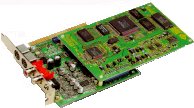 A sound card is an internal device that incorporates two functions: reproducing, by means of a music synthesiser, music encoded by a MIDI system, and recording and playing back real sounds, by means of converting the signal that comes from a microphone into binary digital information (zeros and ones) so that it can be stored by the computer. All sound cards have jacks for input and output. The most common are headphone or speaker jacks (output), microphone jacks (input), and a line in and line out (input and output)and a joystick port, which can also serve as a MIDI interface.

 RTEE
RTEE