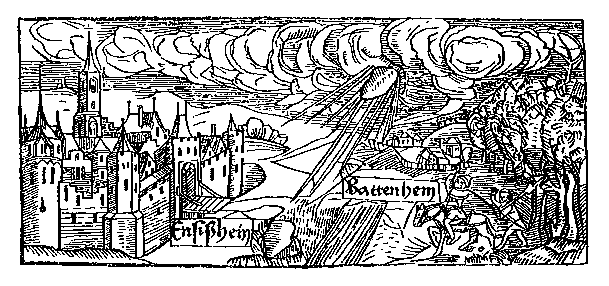
Courtesy Houghton Library, Harvard University
L´any 1492 va caure un meteorit de més
de 100 Kg a prop d'Ensisheim, ciutat d'Alsàcia. El rei Maximilià
va interpretar que es tractava d'un senyal de l'ira divina envers els seus
enemics. El mateix any, mentre creuava l`Atlàntic, Colom va veure
"una meravellosa branca de foc" que queia al mar.
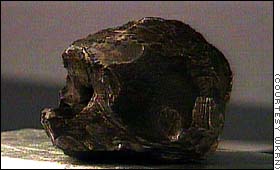
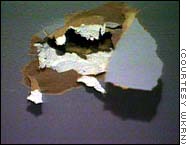 Un
meteorit perfora una teulada
Un
meteorit perfora una teuladaAltres dos meteorits van caure aproximadament a la mateixa hora a la zona oriental de New Mexico, un a una cabana i l'altre a un pati. Hom suposa que es tracta de fragments del mateix objecte.
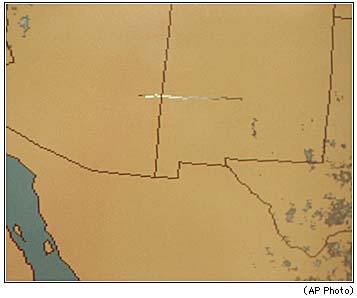 I
matge del bòlid captada per un radar meteorològic.
I
matge del bòlid captada per un radar meteorològic.
Dijous passat s'hi va veure a mig dia un bòlid brillant a sobre de Nuevo Méjico i de l'oest de Texas. Molts van agafar els telèfons per informar del que pensaven haver vist: un avió incendiat, o potser un xoc aeri.
Robert Simpson ho va veure des de casa seva, prop de Fort Davis, i li va agradar molt, perquè tenia una idea més exacta de què es tractava. Simpson és informador del McDonald Observatory, situat 175 milles al sud-est de El Paso.
El meteor va aparèixer a les 12:47 p.m. com un esclat de llum quasi tan brillant com la superfície del sol quan s'amaga, va dir.
Els informes -- de la llum, l'explosió i el rastre de fum -- confirmen que es va tractar d'un bòlid.
"Si hagués passat de nit s'hagués vist el paisatge com si fos de dia" va dir Bill Wren, que també treballa al mateix observatori.
From CNN
Interactive
10 d'octubre, 1997
Aquest xoc es considera un dels dos més destacats del segle. El meteorit, de ferro, es va trencar a uns 8 quilòmetres d'alçada, i els fragments van quedar escampats a una zona d'uns 1600x800 metres. Va produir més de 100 cràters. El més gran tenia un diàmetre de prop de 30 metres. No es va produir cap incendi o destrucció similar, com a Tunguska, només arbres esmicolats i branques trencades. Es van recuperar 23 tones de fragments de ferro. Es suposa que la seva massa abans de trencar-se era d'unes 70 tones.
(from Sky Publishing Corporation and George Zay)
Hal Levinson, del Southwest Research Institute, Carolyn Shoemaker i Eugene Shoemaker han fet una simulació que inclou prop de 200 asteroides Troians, i han arribat a la conclusió de que les seves òrbites no són tan estables com es pensava. Dins d'uns 4.000 milions d'anys, aproximadament el 10 per cent d'aquests asteroides abandonarà el grup. Alguns sortiran del Sistema Solar, expulsats per la interacció gravitatòria amb Júpiter o d'altres planetes, alguns, però, es dirigiran cap als planetes interiors, amb el consegüent perill de col·lisió amb la Terra.
961015054 Santa Fe Fireball
From: healrth@nm-us.campus.mci.net (Jim Cummings)
Date: 4 Oct 1996 04:50:31 GMT
Thursday Oct 3, 8:00pm Saw what appeared to be a low-altitude fireball, heading north from the plains, into the southern end of the Sangre de Cristos, just southeast of Santa Fe.
When I first saw it, it was in full glory; I don't know how much I missed. It burned brilliant green, with active, changing head and tail, for several (3-6) seconds, then disintigrated in a show of gold, into 4 or 5 smaller pieces, glowing white, spread out in a line, until they seemed to burn out, another 3-5 seconds later.
Distance is of course unknown, to me it seemed that the final shards were not far over the foothills. It seemed to be travelling as fast as a low flying airplane.
Looking for another viewer, to help confirm position and height. Any one else happen to see it?
It was surely the most thrilling 10 seconds of my five years of amateur viewing!
Meteor Lights Up Western Skies
A brilliant meteor seen in the skies of the western U.S. on the evening of October 3 was likely a piece of an asteroid or comet, or even a piece of space junk, astronomers said. The meteor was seen from California to New Mexico at around 9pm PDT (4am GMT October 4). It was described by many as a long green streak bright enough to light up sky for several seconds. Hundreds of people contacted local authorities, believing the streak to be the result of a mid-air plane accident. The flash, however, took place too high to be possibly caused by a plane. John Mosley, an astronomer at the Griffith Park Observatory in Los Angeles, attributed the flash to a chunk of comet or asteroid material that burned up in the Earth's atmosphere. JPL officials added the possibility that the meteor was a piece of space junk reentering the Earth's atmosphere. No debris from the meteor was found on the ground.
Recompensa por entregar meteorito LOS ANGELES _ Cinco mil dólares de recompensa ha ofrecido la Universidad de California Los Angeles (UCLA) a quien entregue un fragmento del meteorito que atravesó la atmósfera terrestre i volvió al espacio a principios de este mes. Explica la agencia Efe que el fragmento deberá tener un mínimo de cien gramos de peso, i restos menores recibirán recompensas inferiores. Los científicos no han podido examinar nunca un meteorito que haya entrado en la atmósfera, permanecido un tiempo en la órbita terrestre i luego salido al espacio exterior, por lo que están muy interesados en investigar todo lo posible sobre uno de ellos. El meteorito en cuestión entró en la atmósfera el pasado día 3 sobre el cielo del estado de Nuevo México, donde creó una estrella brillante que siguió su camino hacia Texas, i allí quedó bajo la influencia de la órbita terrestre. El fragmento mayor del objeto celeste salió de la influencia de la órbita de la Tierra a la altura de California i dejó de brillar sobre la zona de Sierra Nevada, donde se oyeron estampidos por la ruptura de la barrera del sonido. En todo ese camino el meteorito debió dejar multitud de pequeños fragmentos que cayeron a la tierra, aunque serán difíciles de encontrar porque el suroeste de EE UU, es una región mayoritariamente desértica i poco poblada.
From: klopes <carlos.lopez@mest.unizar.es>
To: cosmos@rcp.net.pe
Date: Thu, 17 Oct 96 20:00:44 +0100
Yo disiento de la opinión. Cuando cayó el platillo volante (¿o fue un globo sonda...?) en Roswell, aparecieron unos 300 testigos, asi que tiene que ser un desierto singularmente poblado.
961101047 Caltech Seismology Lab Helps Pinpoint Location
of Meteorite Fall
From: Ron Baalke <BAALKE@KELVIN.JPL.NASA.GOV>
Date: Fri, 25 Oct 1996 23:05:38 GMT
For Immediate Release Caltech Seismo Lab gets location data on Oct. 3 meteor
PASADENA- Should anyone be inclined to do a bit of meteorite hunting this weekend for a $5,000 reward, Caltech seismologist Kate Hutton thinks she can provide some help.
According to Hutton, any larger chunks from the meteor that lit up the Western skies on the night of Oct. 3 may have landed in the Rose Valley area near Little Lake. Hutton figured this out by analyzing data from 31 of the seismic stations belonging to the Southern California Seismographic Network (operated by Caltech and the U.S. Geological Survey). "As it fell, the atmospheric drag caused the meteroid to explode in mid-air at least twice," Hutton says. "The explosions generated sound waves in the air similar to a sonic boom, which were detected by the seismographs. Using a procedure that is very similar to the one used to locate earthquakes underground, I used the arrival times of the sound waves at the various seismic stations to estimate where the explosions occurred." Two of the explosions were well located, Hutton adds. Both were 20 to 30 miles above the Fivemile Canyon area in the eastern Sierra foothills. The explosions were separated by about 25 seconds, and the second was about five miles lower than the first and about a mile further eastward. Based on this data and on eyewitness accounts provided by John Wasson of UCLA and Mark Boslough (Ph. D. from Caltech, 1984) of Sandia National Laboratory in New Mexico, Hutton thinks that any larger fragments that survived the firey entry into Earth's atmosphere would have landed to the east-northeast of the explosions, perhaps in the Rose Valley area near Little Lake. Smaller fragments may have fallen more or less straight down from where the explosions occurred.
The Little Lake area would probably be the more seductive area to search, and for a very good reason. UCLA has offered a $5,000 reward for the first fragment that weighs at least four ounces.
Hutton says the seismographic instruments didn't pick up a meteorite impact on Earth, but this is not surprising, since a single fragment would probably have to weigh several tons in order for its impact to be detected. The term "meteorite," by the way, refers to chunks of extraterrestrial debris that survive the entry into the atmosphere and end up on the ground. "Meteoroids" are chunks that travel through space, while "meteor" is the proper designation for the light show produced by a rock from outer space slowing down in the Earth's atmosphere.
Any surviving meteorite fragments would probably have a fresh black matte crust. If the meteorite struck something on the ground, part of the crust might have chipped off to reveal a lighter interior. If anyone finds a meteorite fragment weighing at least four ounces, he or she should get in touch with Dr. John Wasson at UCLA. Wasson's e-mail address is wasson@igpp.ucla.edu.
Contact: Robert Tindol (818) 395-3631 tindol@caltech.edu
Els informes es poden classificar en dos grups: un corresponent al bòlid observat a Texas i a la zona oriental de New Mexico, i un altre, 104 minuts després, a Bakersfield (California). Alguns científics van suposar que es tractava del mateix objecte que, després d'haver penetrat l'atmosfera a sobre de Texas, havía rebotat, havía donat la volta a la Terra i havía tornat a entrar a sobre de California.
Després d'analitzar curosament un vídeo obtingut des de El Paso (Texas) i les entrevistes amb els testimonis, però, Mark Boslough (que treballa als Sandia National Laboratories) i Peter Brown (de la universitat de Western Ontario), han arribat a la conclusió de que el primer bòlido va entrar a l'atmosfera amb un angle massa vertical perquè pogués rebotar. Per tant, es trata de dos bòlids diferents.
També han determinat a quina zona és més probable trobar-hi fragments d'un dels meteorits, al sud d'Amarillo i prop de les ciutats Hereford i Canyon. El vent pot haver desviat alguns fragments de la trajectòria de caiguda. Els fragments petits podríen ocupar una àrea el.líptica a l'est/sud-est de Hereford, els més grans podríen trobar-se fins a 10 milles a l'est de Canyon. Aquesta zona de Texas és famosa per la freqüència amb la que es troben meteorits. Es tracta d'una regió plana, amb poca vegetació i quasi sense pedres. Al sud-oest de Plainview es van recuperar 900 fragments després de la "pluja" de 1903, i es van continuar trobant fins al 1949.
Al menys 60 objectes van penetrar l'atmosfera dins d'un interval de poques hores al voltant de la caiguda dels dos bòlidos principals, segons es pot deduir de ls explosions registrades amb els detectors de baixa freqüència dels Los Alamos National Laboratory i de la National Oceanic and Atmospheric Administration, dues de les quals també van ser detectades pels satèl.lits del Defense Department.
La hipòtesi de que un mateix objecte va entrar a la atmosfera dues vegades ha quedat descartada, però encara té interès recuperar mostres d'aqueesta "pluja" de meteorits, per esbrinar si es tracta de fragments d'un asteroide. El professor John Wasson, del Institute of Geophysics UCLA, a Los Angeles, California, ofereix una recompensa de 2.000 dolars al primer que trobi una mostra de més de 4 unçes. Recomana mirar als camps de conreu, a les teulades i als depòsits d'aigua, llocs on no acostuma a haver-hi cap pedra. També recorda als caçadors de meteorits que és probable que siguin de color negre mat, i que cal demanar permís als propietaris de les terres, doncs també són propietaris dels meteorits que hi cauen.
Meteorite Falls From Oct 1996
From: Ron Baalke <BAALKE@kelvin.jpl.nasa.gov>
Date: Wed, 8 Oct 1997 14:14:51 GMT
NEWS RELEASE OCT. 1, 1997Albuquerque, N.M. After a year of detective work involving scores of eyewitness reports from across New Mexico and Texas, a group of scientists has concluded that the Earth collided with a swarm of cosmic debris on the night of Oct. 3-4, 1996.
The most widely-reported fireballs were ones over eastern New Mexico and the Texas panhandle, and another near Bakersfield, California, exactly 104 minutes later. The relationship among the times, locations, and trajectories of the meteors seemed too unlikely to be mere coincidence, and had initially led some scientists to believe that a single object skimmed through the atmosphere and re-entered after a single orbit.
After careful analysis of a videotape taken from El Paso, Texas, together with eyewitness reports, Mark Boslough of Sandia National Laboratories and Peter Brown of the University of Western Ontario found that the first meteor entered at too steep of an angle to skip off the atmosphere. They are now convinced that the two fireballs observed over New Mexico/Texas and over California were two different objects.
They also determined the most likely location in the Texas panhandle where meteorites might have fallen, and John Wasson (UCLA) has re-issued a reward for a sample. Brown and Boslough believe that any meteorites reaching the ground in the Southwest would most likely be found south of Amarillo, near the towns of Hereford and Canyon, where they were carried by winds to the east of the visible trajectory. The most likely place for small meteorites to have landed would be in an oblong area about 10 miles ESE if Hereford, but any larger meteorites would be in a strip that stretches as far as 10 miles east of Canyon.
This part of the Texas Panhandle is well-known for its abundance of meteorite finds because it is flat, with little vegetation and few natural rocks on the surface. The most famous area is southwest of Plainview, where over 900 meteorites were recovered after they fell in 1903, and were still being found as late as 1949.
Over the past year, two groups of scientists from Los Alamos National Laboratory and the National Oceanic and Atmospheric Administration have also reported low-frequency sound data showing that the Earth's atmosphere was hit by at least 60 objects within several hours of the two that were originally reported, two of which were also observed by Defense Department satellites.
Most of the infrasound-producing meteors occurred during daylight hours and were not seen by witnesses, but the large number of collisions taking place that night helps explain why two bright ones with such similar trajectories would be seen so closely spaced in time. Although the scientists eliminated their hypothesis of a single object bouncing off the atmosphere and re-entering it later, they are still very interested in the events of one year ago because it means the Earth collided with a cluster of objects, perhaps pieces of a broken asteroid. A sample of one of these meteorites would help scientists determine what kind of asteroid spawned the fragments and better understand how they break apart and explode in the atmosphere, says Sandia's Mark Boslough.
Prof. John Wasson is seeking such samples and is offering
a reward of $2,000 for the first confirmed sample as large as 4 ounces,
and he urges persons living within the calculated fall area to look in
their fields, on the roofs of buildings, in stock tanks and other locations
where stones would not be expected. Meteorite hunters are reminded to get
permission of land owners, and that any stones automatically belong to
the owner of the property on which it is found. The stones are most likely
to be black with a fresh matte texture. Samples should be sent to Prof.
Wasson at the Institute of Geophysics, UCLA, Los Angeles, CA 90095, or
to Dr. Adrian Brearley, Institute of Meteoritics, University of New Mexico,
Albuquerque, NM 87131. Each sample will be acknowledged, but those that
are not meteorites will not be returned unless a return self-addressed
envelope is provided.
In 1962, a meteorite landed near Zagami, Nigeria about 10 feet away from a farmer who was trying to chase crows from his corn field. The farmer heard a tremendous explosion and was buffeted by a pressure wave. After a puff of smoke and a thud, the meteorite buried itself in a hole about 2 feet deep. The Zagami meteorite was later identified as a Mars meteorite. Weighing at about 18,000 grams (40 pounds), the Zagami meteorite is the largest single individual Mars meteorite ever found.
The new photos include Zagami, Chassigny, Nakhla, Lafayette, ALH 84001, ALHA 77005 and QUE 94201.
I have photos of 11 of the 12 known Mars meteorites, and the one I'm missing is Yamato 793605. If anyone has a photo of this meteorite, I'd appreciate it if you contact me.
Ron Baalke baalke@kelvin.jpl.nasa.gov
Podrà algú trobar un fragment del meteorit del 3 d'octubre de 1996 i guanyar els 5000 dòlars de recompensa?...
O es va volatilitzar del tot a una explosió daurada?