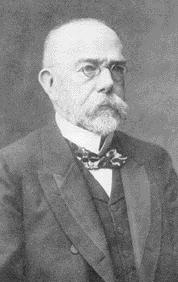
ROBERT KOCH
Robert Koch attended the University of Göttingen, where he studied medicine, graduating in 1866. Equipped with a microscope he began his study of pathogenic (disease-causing) organisms.
He cultivated the anthrax organisms in suitable media on microscope slides, demonstrated their growth into long filaments, and discovered the formation within them of spores. Koch found that the dried spores could remain for years. The finding explained the disease in pastures.
In 1877 Koch published an important paper on the investigation and preservation of bacteria. His work was illustrated by superb photomicrographs. He described his method of preparing thin layers of bacteria on glass slides and fixing them by heat.
In 1878 Koch by inoculating animals with material from various sources, he produced six types of infection, each caused by a specific microorganism. He then transferred these infections by inoculation through several kinds of animals, reproducing the original six types. In that study, he observed differences in pathogenicity for different species of hosts and demonstrated that the animal body is an excellent apparatus for the cultivation of bacteria.Koch, now recognized as a scientific investigator of the first rank, obtained a position in Berlin in the Imperial Health Office, where he set up a laboratory in bacteriology. Koch determined guidelines to prove that a specific organism causes a disease. These four basic criteria, called Koch's postulates, are:
- A specific microorganism is always associated with a disease.- The microorganism can be isolated from the diseased animal and grown in pure culture in the laboratory.
- The cultured microbe will cause disease when transferred to a healthy animal.
-The same type of microorganism can be isolated from the newly infected animal.