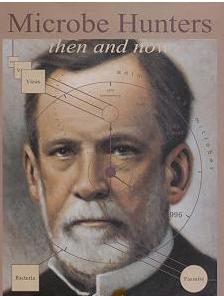
THE MICROBE HUNTERS
The major killers of humanity -Plague, smallpox, flu, tuberculosis, malaria, measles, and cholera- are infectious diseases that evolved from diseases of animals.
Because diseases have been the biggest killers of people, they have also been decisive shapers of history.
Naturally, we are disposed to think about diseases just from the point of view of humans : what can we do to save ourselves and to kill the microbes?
In life in general, and in medicine, we have to understand the enemy to beat him.
Basically, microbes evolve like other species. For a microbe evolution selects those individuals that infect a major number of victims. That number depends on how long each victim remains capable of infecting new victims, and how efficiently a microbe is transferred from one victim to the next.
The work of Pasteur and Koch meant that the real cause of disease was known at last.
Pasteur's advice to "seek the microbe" was followed. The new science of
bacteriology was established. Microbe hunters became the stars of scientific research.
The discovery of specific microbes led to the production of vaccines, and later of chemotherapy. The mass murderers of earlier times were being controlled.Here are the years that particular microbes were discovered by scientists microbe hunters:
1879 Leprosy Hansen
1880 Typhoid Eberth
1882 Diphtheria Klebs
1884 Tetanus Nicholaier
1884 Pneumonia Frankael
1894 Plague Kitasato and Yersin