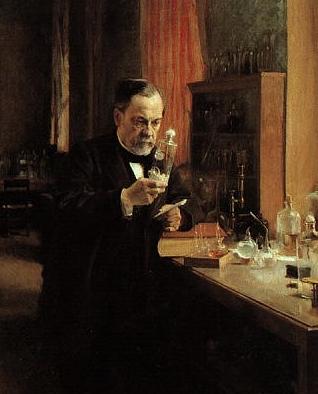
LOUIS PASTEUR
Louis Pasteur was a French chemist and microbiologist whose contributions were among the most varied and valuable in the history of science and industry. He proved that microorganisms cause fermentation and disease; he created and was the first to use vaccines for rabies, anthrax, and chicken cholera; he saved the beer, wine, and silk industries of France and other countries; he did important work in the process known as pasteurisation.
Although Pasteur was partially paralysed in 1868 and applied for retirement from the university, he continued his researches.
In 1881 he perfected a technique for reducing the virulence of various disease-producing microorganisms, he succeeded in vaccinating a herd of sheep against the disease known as anthrax. He was able to protect fowl from chicken cholera. He had observed that once animals with certain diseases recovered they were later immune to a new attack. By isolating the germ of the disease and by cultivating an attenuated, or weakened, form of the germ and inoculating fowl with the culture, he could immunize the animals against the malady. In this he was following the example of the English physician Edward Jenner in his method for vaccinating animals against cowpox.
After experimenting with inoculations of saliva from infected animals, he came to the conclusion that the rabies virus was also present in the nerve centres, and he demonstrated that a portion of the medulla of a rabid dog, when injected into the body of a healthy animal, produced symptoms of rabies. By further work on the dried tissues of infected animals and the effect of time and temperature on these tissues, he was able to obtain a weakened form of the virus that was used for inoculation. Having detected the rabies virus by its effects on the nervous system and attenuated its virulence, he applied his procedure to man; on July 6, 1885, he saved the life of a nine-year-old boy, Joseph Meister, who had been bitten by a rabid dog. The experiment was a success, opening the road to protection from a terrible disease. In 1888 the Pasteur Institute was inaugurated in Paris for the purpose of fundamental research, prevention, and treatment of rabies.
Louis Pasteur made a veritable revolution in the 19th-century scientific method. By abandoning his laboratory and by fighting the agents of disease in their natural environments, he was able not only to identify the agent responsible for a disease but also indicate the remedy.
Pasteur dedicated himself with immense enthusiasm to science and its applications to medicine, agriculture, and industry. He defended his ideas with courage. It was in his work on spontaneous generation and on rabies that he encountered the strongest opposition to his ideas (which were, for the time, revolutionary) from medical circles and the press. A great friendship developed between Pasteur and the renowned British surgeon Sir Joseph Lister who was quick to apply to his own discipline the discoveries of his French colleague.