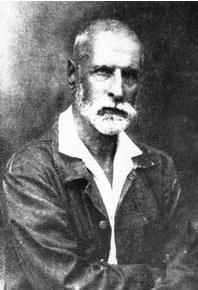
YERSIN AND KITASATO
Alexandre Yersin studied medicine at the universities of Marburg and Paris and bacteriology with Émile Roux in Paris and Robert Koch in Berlin. Yersin left Europe in 1890 to work as a physician in Indochina and soon began his four-year exploration of the central region.
Yersin established a laboratory at Nha Trang. There he prepared serums against Plague in human beings and cattle and studied cattle diseases, tetanus, cholera, and smallpox. In 1892 he joined the colonial health service and was sent to Hong Kong in 1894, where he and Kitasato Shibasaburo independently discovered the Plague bacillus.The fundamental but separate works by Yersin and Kitasato in 1894 on the discovery of the etiologic agent of Plague in Hong Kong opened the way for investigating the disease and how it is spread. Kitasato and Yersin described the presence of bipolar staining organisms in the swollen lymph node (bubo), blood, lungs, liver and spleen of dead patients. Cultures isolated from patient specimens were inoculated into a variety of laboratory animals, including mice. These animals died within days after injection, and the same bacteria as those found in patient specimens were present in the animal organs. Yersin had recorded that rats were affected by Plague not only during Plague epidemics but also often preceding such epidemics in humans. PIague was designated, in local languages, as a disease of the rats: in China, India and Taiwan people described that when hundreds and thousands of rats died Plague soon followed in people.