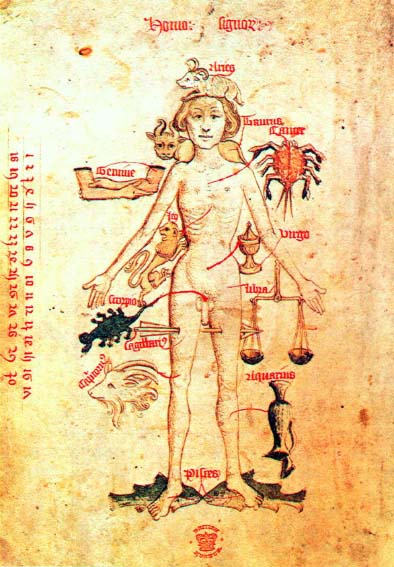
ASTROLOGY AND ALCHEMY
Contrary to popular belief, science was not dead during the medieval period. Astrology, alchemy, and astronomy were practiced if not fully understood, and in the twelfth and thirteenth centuries, the works of the ancient Greeks began to be studied again.
Alchemy was introduced into Europe at the time of the Crusades. The first alchemical texts were translated from Arabic into Latin. The alchemist's work was based on Aristotle's theory of earth, air, fire, and water. These four elements were related to the four humours: phlegm, blood, bile, and black bile.
In a healthy human, the humours were balanced; illness was a deficiency or surplus of one of the humours. Many alchemists looked for moral perfection, believing that what was done in nature could also be done in the heart and mind.
Alchemy was a mysterious and terrifying art to those unfamiliar with it. Alchemists used strange instruments and magical incantations, codified symbols and symbolic colours .
Science was considered a challenge to the authority of the Church, as were many things not understood by everyone. Aristotle's books were banned.
Astrology also dated back to the Egypcians, Persians and Greeks. An astrologer used to forecast the life of an infant King or Queen by observing the alignment of the stars and planets at the moment of his or her birth.