ECONOMIC CONSEQUENCES
The Black Death dominated the economy of the 14th century. Hard rains in 1315 and 1316 caused famine and animal epidemics added to the problems. The Black Death, possibly a combination of bubonic and pneumonic plagues, killed from one-third to one-half of the population.
The rate of mortality from the Black Death varied from place to place: some districts, like Milan, Flanders, and Béarn, almost escaped, others, like Tuscany, Aragon, Catalonia, and Languedoc, were very hard hit. Towns, where the danger of contagion was greater, were more affected than the countryside; and in the towns the monastic communities had the highest incidence of victims. Even the great and powerful, who were more capable of protection also died: among royalty, Eleanor, queen of Peter IV of Aragon, and King Alfonso XI of Castile succumbed, and Joan, daughter of the English king Edward III, died at Bordeaux on the way to her wedding with Alfonso's son. Whole communities and families were sometimes annihilated.
The population in England in 1400 was perhaps half what it had been 100 years earlier; in that country alone, the Black Death certainly caused the depopulation or total disappearance of about 1,000 villages. A rough estimate is that 25 million people in Europe died from Plague during the Black Death. The population of western Europe did not again reach its pre-1348 level until the beginning of the 16th century.
Before the Plague labour was cheap and plentiful. After the Black Death in many places there was plenty of land and a shortage of peasants. This put the landlords in a weak position. Wages rose rapidly and prices of agricultural products fell for lack of demand.
Cities were hit hard by the Plague. Financial business was interrupted as debtors died and their creditors found themselves without recourse. Not only the debtor died, his whole family had died with him. There was simply no one to pay.
Construction projects stopped for a time or were abandoned forever. Some cathedrals were never finished. Guilds lost their craftsmen and could not replace them. Mills and other special machinery broke and often the only man in town who had the skill to repair it had died in the Plague.
Towns advertised for specialists, offering high wages. The labour shortage was very important, especially in the cities and towns, and consequently, salaries rose. Because of the mortality, there was scarcity of manufactured goods, and so prices went up.
Effects in the countryside were also severe. Farms and entire villages were abandoned and the few survivors decided not to stay. Whole families died, with no heirs, their houses empty. When the countryside faced an immediate shortage of labour the landlords reacted against their serfs. They tried to get more forced labour from them, as there were fewer peasants.
When Norwegian sailors finally visited Greenland again in the early 15th century, they found in the settlements there was only wild cattle in the streets of the deserted villages.
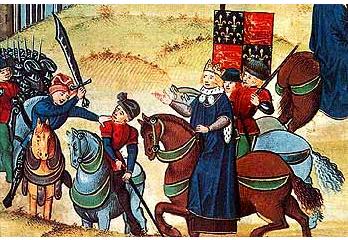
Peasants in many areas began to demand fairer treatment or lighter burdens. Just as there were guild revolts in the cities in the later 1300s, so we find rebellions in the countryside. The Jacquerie in 1358 in France, the Peasants' Revolt in England in 1381, the Catalonian Rebellion in 1395, and many revolts in Germany, all serve to show how seriously the mortality caused by the Black Death had changed economic and social relations.