THE FOUR HUMOURS
Many physicians based their philosophies on the teachings of Hippocrates. Some physicians still believed that if the planets were out of line, an individual would get sick, according to his or her own sign.
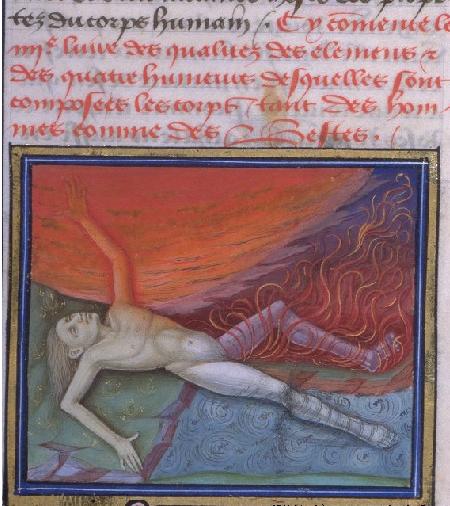
The strongest and most widespread belief was that of the four humours and four elements. The humours are bodily fluids, and the seat of all these fluids was thought to be the liver.The four humours are blood, phlegm, yellow bile, and black bile. Supposedly the level of humours in the body characterized the personality.
If a person had more blood in his body, he was characterized as having a sanguine personality. These people were very passionate, amorous, joyful, and kind.
With abundance of phlegm, the personality was characterized as being phlegmatic or cowardly, unresponsive, and lacking in intellectual ability.
Yellow bile meant that the person had a choleric personality. These people were generally believed to be obstinate, vengeful, impatient, and easily angered.
Black bile meant that the person was melancholy or excessively gluttonous, and satiric.
They believed that too much of any of them caused disease, and that the cure lay in purging the humour: by reducing the amount of blood by cupping or reducing the bile by means of drugs.
There were also four elements that were thought to determine a person's personality and health. The four elements were air, water, earth, and fire. Air was the cold element, water the moist, earth the dry, and fire was the hot element.
Physicians also believed that certain gemstones had medicinal powers.