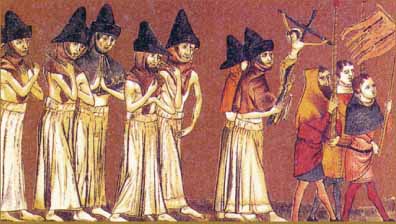
THE FLAGELLANTS
In Hungary, and afterward in Germany, the Brotherhood of the Flagellants, called also the Brethren of the Cross took the repentance of the people for the sins they had committed, and offered prayers and supplications for the end of the Plague.
They marched through the cities with leaders and singers, their heads covered. They were dressed with red crosses on the breast, back, and cap.
In 1349 two hundred Flagellants first entered Strasburg, where the citizens hospitably lodged them. All Germany, Hungary, Poland, Bohemia, Silesia, and Flanders welcomed them. The influence of this fanaticism was great and threatening.If the Plague was a manifestation of divine anger, then Christians should do all they could to diminish that anger. From this simple impulse came the Flagellants: bands of people who went through towns and countryside doing penance in public.
They inflicted all sort of punishments on themselves, trying to pay for the evil of the world, sacrificing themselves for the world's sins in imitation of Jesus.
Society was generally surprised at them and did not approve. The Flagellants showed a tendency to kill the Jews they encountered, and even killed clergymen who spoke against them. In October 1349 the Pope condemned them and ordered all authorities to suppress them.
A description of the Flagellants from Jean de Venette, died in 1368 (a Carmelite monk who witnessed the advance of the Black Death in France in 1350s):
"While the Plague was still active and spreading from town to town, men in Germany, Flanders, Hainault and Lorraine began a new sect on their own authority. Naked to the waist, they gathered in large groups and bands and marched in procession through the crossroads and squares of cities and good towns. They formed circles and beat upon their backs with wipes, singing hymns. For 33 days they marched through many towns doing penance and giving a great spectacle to the surprised people. They wiped their shoulders and arms, with iron points so furiously as to draw blood."