THE DANCE OF DEATH
Death has always been present in religious art, but after the Plague it became present in different artistic manifestations.
Special attention has The "Dance of Death" that has been traced back to the middle of the fourteenth century. The epidemics so frequent and so destructive at that time, such as the Black Death, were the subject of death and its universal presence. The danse macabre medieval has the concept of the equalizing power of death. It was expressed in the drama, poetry, music, and visual arts of Western Europe in the late Middle Ages. It is a literary or pictorial representation of a procession or dance of both living and dead figures, the living arranged in order of their rank and the dead leading them to the grave. The dance of death had its origins in 13th- or early 14th-century poems but the concept gained popularity in the late Middle Ages as a result of the obsession with death inspired by an epidemic of the Black Death in the mid-14th century.
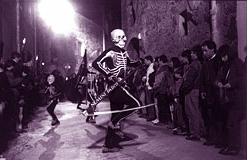
The Dansa de la Mort from Verges is the only dance from this genre that has survived over the years.The Dance of Death, a kind of dance which was very common all over West Europe in the Middle Ages is now a unique relic preserved in the Procession of Verges (Catalonia). During the Middle Ages, the Dansa de la Mort was spread through the whole Eastern Europe. Five agile dancers in luminescent skeleton costumes play the fool to the crowds in a dance. This known by the name of Dansa de La Mort or The Dance of Death is played on the evening of Maundy Thursday (the Thursday before Easter), men and boys dressed as skeletons march through the village of Verges performing the Medieval dance of death.
The purpose of these plays was to teach the truth that all men must die and must prepare themselves to appear before their Judge. The scene of the play was usually the cemetery or churchyard, but sometimes was the church itself. The spectacle was opened by a sermon on the certainty of death delivered by a monk.
The oldest traces of these plays are found in Germany, but we have the Spanish text for a similar dramatic performance dating back to the year 1360, "La Danza General de la Muerte". We read of similar dramatic representations elsewhere: in Brugges before Duke Philip the Good of Burgundy in 1449; in 1453 at Besançon in Franceand also in the Cimetière des Innocents near Paris in 1424.
In Italy with the traditional dance of death there was spectacular representations of death as the all-conqueror in the "Trionfo della Morte". The earliest traces of this conception are found in Dante and Petrarch. In Florence (1559) the "triumph of death" formed a part of the carnival celebration.
As the painter's art developed, the dance of death was painted on the enclosing walls of cemeteries, in mortuary chapels, and even in churches. These representations are found in most of the countries of Europe. One of the most famous is the "Triumph of Death" in the cemetery of Pisa, painted between 1450 and 1500.
The paints show skeletons mixed with living men in daily scenes. We see peasants at a harvest festival, or workmen at a construction site, or hunters in a forests. And in each scene, mixled with the living, are skeletons: skeleton horses carry corpses to the hunt; peasant girls dance with death; a skeleton receives an infant from its baptismal font.